
Rub Ranking: Full Simple English Guide
Rub Ranking is a fair and organized method used to judge, score, and rank different items, people, performances, or ideas. It is based on a rubric, which is a scoring guide that includes rules, criteria, and score values. This method helps people make decisions with clarity, fairness, and confidence instead of guessing or using emotional opinions. Rub Ranking can be used in many different areas, such as schools, companies, competitions, projects, talent shows, research reviews, and training programs. It is trusted because every subject, item, or person is evaluated under the same scoring rules, which makes the final result honest, logical, and easy to understand.
Today, people and organizations need fair ways to compare many different things. Life has more options than before, including products, skills, information, and services. Rub Ranking helps reduce confusion and brings structured thinking, making it an important tool for evaluation and decision-making ecryptobit
Rub Ranking Meaning
Rub Ranking means using a rubric-based scoring method to judge and rank different items. A rubric is a set of rules, qualities, and points that must be checked during evaluation. Instead of choosing a winner, best performer, or top product randomly, Rub Ranking uses criteria and score scales to decide who or what performs best. The final result is calculated through points, not opinion, which makes Rub Ranking a transparent and fair method.
For example:
if three students present a project, the teacher does not choose a winner based only on feelings or personal preference. Instead, the teacher creates a rubric that includes criteria such as clarity, creativity, accuracy, presentation style, and usefulness. Each student receives points in each category, and the one with the highest total score becomes the winner. This way, everyone understands why the result was given, and no one feels unfairly judged.
Why Rub Ranking Is Needed
Rub Ranking is needed because people often disagree when they judge something without a clear system. When decisions are emotional, some people feel disappointed, confused, or mistrusted. Rub Ranking removes these problems by using rules that everyone knows before evaluation begins. It helps students, employees, creators, and competitors to understand expectations and work toward improvement. It also helps evaluators defend their decisions because the scoring is written, explained, and recorded, in public competitions or school activities, Rub Ranking also builds trust and respect. People are more willing to accept results when they believe the method was equal, fair, and open.
How Rub Ranking Works Step-by-Step
Rub Ranking works through a few simple steps. First, the evaluator decides what needs to be judged. Second, the evaluator selects the criteria, which are the important features or qualities to be checked. Third, the evaluator chooses a scoring scale, such as 1 to 5 or 1 to 10. Fourth, the evaluator decides if some criteria are more important and assigns weight values. Fifth, the evaluator scores each item carefully. Lastly, all scores are added, and the items are arranged from highest to lowest total score. The item with the highest score receives the top rank, this method can be applied with paper, pen, spreadsheets, score sheets, or digital apps. The most important part is that all items receive the same scoring treatment.
Important Elements of Rub Ranking
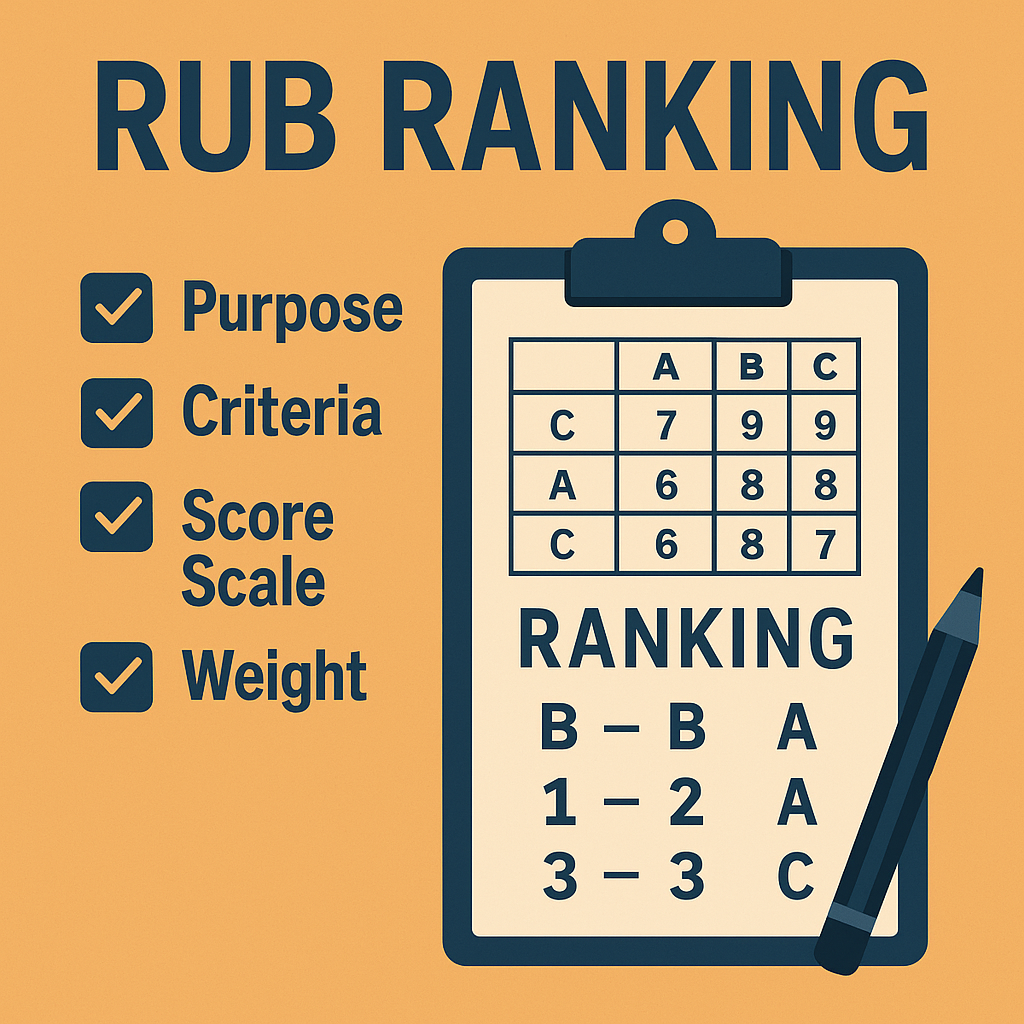
Rub Ranking depends on four important elements:
-
Purpose — what is being judged and why
-
Criteria — qualities to check, such as clarity or creativity
-
Score Scale — numbers used to evaluate, such as 1–5
-
Weight — how important each criterion is in total scoring
When these four elements are properly created, Rub Ranking becomes strong, useful, and trusted.
Choosing Criteria for Rub Ranking
Criteria are the qualities that evaluators check during scoring. Good criteria must be simple, clear, and measurable. They should not include personal taste such as “I like it” or “I do not like it.” Instead, they should include qualities such as quality, clarity, creativity, accuracy, usefulness, safety, or completeness. The criteria should match the purpose of the evaluation. For example, if judging a science project, accuracy and facts matter more than artistic style. If judging artwork, creativity and presentation may matter more than data accuracy.
Where Rub Ranking Can Be Used
Rub Ranking can be used in many situations, such as:
-
Education — judging projects, assignments, speeches, writing, or experiments
-
Competitions — art, design, singing, dancing, science, and invention contests
-
Workplace evaluation — skill review, promotion plans, job interviews
-
Product comparison — comparing gadgets, tools, clothing, toys, or vehicles
-
Research and proposal review — idea strength, benefit, clarity, and value
-
Training and workshops — measuring learning progress and performance
This shows that Rub Ranking is flexible and useful for many fields.
Suggested Weight Scale Based on Importance
| Importance Level | Meaning | Suggested Weight |
|---|---|---|
| Very High | Most important requirement | 4–5 |
| High | Strong influence on final result | 3–4 |
| Medium | Helpful but not the top factor | 2–3 |
| Low | Optional, bonus, or extra value | 1–2 |
Weight values ensure that important criteria receive proper value.
Benefits of Rub Ranking
Rub Ranking gives many benefits. It makes judging and ranking simple, organized, and fair. It reduces arguments because results come from a scoring method and not from personal feelings. Rub Ranking also helps people understand what they did well and what they can improve. When people know the criteria, they work harder and try to match expected results. This helps develop skill, confidence, and responsibility. Rub Ranking is also easy to record, share, and review, which makes it useful for schools, offices, and competitions, another benefit is that Rub Ranking supports better communication. When someone asks why a score was given, the evaluator can show the rubric and explain. This builds trust and removes misunderstanding.
Common Challenges and Precautions
Rub Ranking also has some challenges. One challenge is when evaluators choose unclear criteria. For example, if they use the word “impressive,” different people may understand it differently. Another problem is giving equal weight to every criterion when some factors should matter more. Also, some evaluators may allow personal feelings to affect scoring even though a rubric exists. To avoid such issues, rubrics should be explained to all evaluators, and scoring must follow written rules, not emotions, it is also important that rubrics are tested and updated over time. If a rubric stays the same for many years, it may become outdated or no longer match goals.
Tips and Best Practices for Better Rub Ranking
To make Rub Ranking work well, keep criteria simple and easy to understand. Do not add too many criteria because it may create confusion. Use a scoring scale that is comfortable for evaluators. Explain the rubric before scoring begins, so participants know expectations. After evaluation, share meaningful feedback because feedback can help people improve their performance or product. Try to use more than one evaluator if possible, because shared judgment reduces error.
Real-Life Examples of Rub Ranking
Rub Ranking can be used in many real-life examples. In schools, teachers can use rubrics to score class presentations, science models, creative writing, or group work. In offices, managers can use rubrics for career performance reviews, interview scoring, or promotion decisions. In competitions, judges can use Rub Ranking to score dance moves, singing quality, artwork design, or product invention. In daily life, families can even use simple rubrics for planning the best holiday choice, selecting safe items, or deciding between multiple options, one strong point is that RubRanking can help in fair conflict resolution. When a disagreement occurs, the rubric and scores can be reviewed step-by-step, making discussion easier and more respectful.
Role of Technology in Rub Ranking
Modern technology supports RubRanking by offering digital score sheets, mobile apps, and simple spreadsheets. Digital tools can calculate totals automatically, which reduces math errors. Some tools also allow multiple evaluators to add scores and comments at the same time. Even though technology helps, the success of RubRanking still depends on clear criteria, fair scoring, and good explanation.
FAQs
What is RubRanking?
RubRanking is a way of judging and scoring items, people, or performances using clear rules and points so that the final result is fair and easy to understand.
Why is RubRanking used?
It is used to reduce confusion, avoid emotional judgment, and help evaluators make fair and clear decisions based on the same standards.
Who can use RubRanking?
Teachers, managers, judges, trainers, students, parents, and anyone who needs a fair way to compare or choose between different options.
What do I need to create a RubRanking system?
You need a purpose, clear criteria, a score scale, and weight values to show the importance of each criterion.
Does RubRanking work for group evaluation?
Yes, RubRanking works well for teams because it helps everyone follow the same scoring system and reduces arguments.
Can RubRanking change over time?
Yes, criteria and score rules can change if goals or needs change. Updating the rubric is a good practice.
Conclusion
RubRanking is a simple, fair, and organized method of judging and ranking different items, people, or ideas. It removes confusion and emotional decision-making by using clear rules and score values. Anyone can use RuRanking, including students, teachers, judges, managers, trainers, parents, and event organizers. With correct criteria, proper scoring scales, and thoughtful weight values, the results of RubRanking become trustworthy, honest, and easy to explain. In today’s world, where fairness, clarity, and transparency matter, RubRanking is a helpful evaluation system that supports better decisions and personal improvement.